
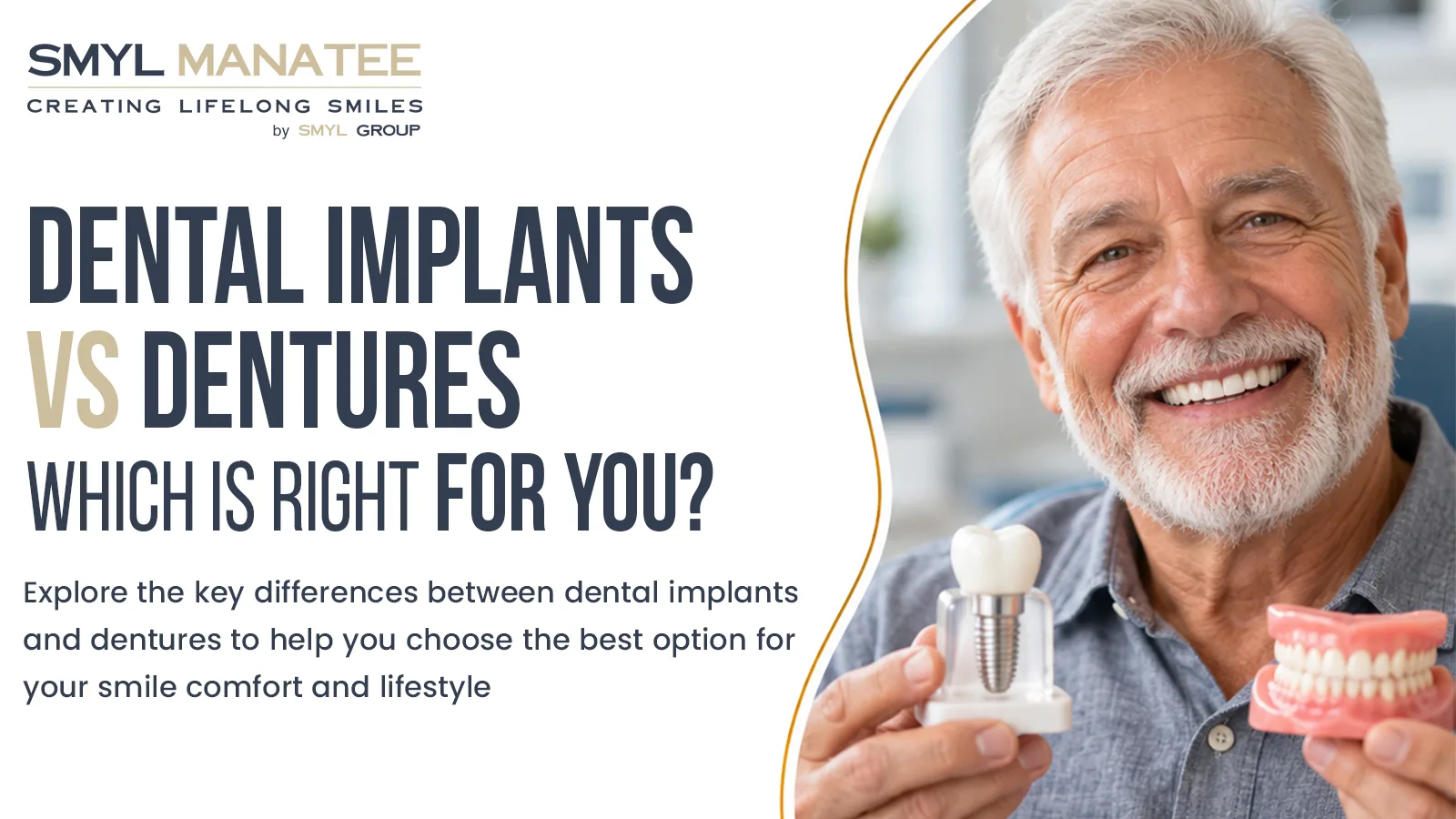
Dental Implants vs. Dentures: Which Is Right for You?
Compare dental implants and dentures to understand the benefits, differences, and factors to consider when replacing missing teeth.
Losing one or more teeth can affect much more than your smile. Missing teeth can make eating and speaking more difficult, change the way your remaining teeth function, and impact your confidence.
Fortunately, there are several options for replacing missing teeth. Two of the most common are dental implants and dentures.
But which option is right for you?
The answer depends on several factors, including how many teeth you’re missing, your oral health, your jawbone condition, your lifestyle, and your long-term goals.
If you’re considering tooth replacement in Bradenton, FL, Lakewood Ranch, Palmetto, or surrounding Manatee County, here’s what you should know about dental implants versus dentures.
What Are Dental Implants?
Dental implants are designed to replace missing teeth in a way that closely resembles the structure of a natural tooth.
A dental implant typically consists of:
- An implant post that is placed into the jawbone
- An abutment that connects the implant to the restoration
- A crown, bridge, or denture that replaces the visible portion of the missing tooth or teeth
Because the implant is anchored in the jawbone, it can provide a stable foundation for replacement teeth.
Dental implants can be used to replace a single missing tooth, several missing teeth, or support a full-arch restoration depending on the patient’s needs.
What Are Dentures?
Dentures are removable dental appliances designed to replace missing teeth.
Depending on how many teeth need to be replaced, you may hear about:
Complete dentures: Replace an entire arch of missing teeth.
Partial dentures: Replace several missing teeth while working around remaining natural teeth.
Dentures can restore the appearance of your smile and help improve chewing and speaking.
Modern dentures can be designed to look natural and provide a comfortable fit when properly made and maintained.
Dental Implants vs. Dentures: The Key Differences
While both options can replace missing teeth, they work differently.
Feature | Dental Implants | Dentures |
Removable | Usually no | Yes |
Stability | Anchored in the jaw | Rests on gums and/or uses other retention |
Can replace one tooth | Yes | Generally not the typical choice |
Can replace multiple teeth | Yes | Yes |
Can replace a full arch | Yes, with implant-supported solutions | Yes |
Jawbone stimulation | Helps maintain bone through functional loading | Does not provide the same stimulation |
Maintenance | Similar to caring for natural teeth, depending on restoration | Requires removal and appliance care |
Treatment timeline | Typically longer | Often faster |
Surgical procedure | Yes | No implant surgery |
Neither option is automatically better for every patient. The right choice depends on your individual situation.
1. Dental Implants Can Feel More Like Natural Teeth
One of the biggest reasons patients choose dental implants is stability.
Because implants are anchored into the jawbone, they don’t rely solely on suction, adhesives, or the shape of the gums to stay in place.
For many patients, this can make eating and speaking feel more natural.
Implants may also help you avoid some of the movement that can occur with traditional removable dentures.
2. Dentures Can Be a Practical Tooth Replacement Option
Dentures remain a popular option because they can replace multiple missing teeth without implant surgery.
They can be particularly useful for patients who:
- Need to replace many or all missing teeth
- Prefer a removable solution
- Are not currently candidates for implants
- Want a potentially simpler treatment approach
However, dentures do require regular care and may need adjustments over time as your mouth changes.
3. Your Jawbone Matters
One important difference between the two options involves the jawbone.
When a natural tooth is lost, the bone surrounding that tooth no longer receives the same stimulation it once did. Over time, bone loss can occur.
Dental implants are placed into the jawbone and can help maintain bone in the area through functional loading.
Traditional dentures sit over the gums and do not replace the tooth root, so they do not provide the same type of stimulation to the jawbone.
If you’ve been missing teeth for a long time, your available bone may also affect whether implants are an option. In some situations, additional procedures may be considered before implant placement.
4. Think About How You Want to Eat
Eating comfortably is an important part of choosing a tooth replacement option.
Traditional dentures can restore chewing ability, but some patients may find that certain foods are more challenging to eat, particularly if the denture moves or doesn’t fit properly.
Implant-supported teeth are secured more firmly, which can provide greater chewing stability.
Your dentist can evaluate your bite, jawbone, and remaining teeth to help determine which approach makes sense for you.
5. Consider Your Daily Routine
Both dental implants and dentures require maintenance.
With implants, your care routine depends on the type of restoration you receive. Implant-supported crowns and bridges generally require brushing, flossing, and professional dental care.
Dentures require:
- Daily cleaning
- Proper storage when removed
- Regular dental evaluations
- Periodic adjustments or replacement when needed
Your lifestyle and willingness to maintain your restoration should be part of the decision.
6. What About Cost?
Cost is naturally an important consideration when replacing missing teeth.
Generally, dental implants require a larger initial investment than traditional dentures because implant treatment may involve surgery, multiple appointments, diagnostic imaging, and customized restorations.
Dentures can have a lower initial cost, depending on the type and complexity of treatment.
However, it’s important to look beyond the initial price.
The long-term value of a tooth replacement option depends on factors such as durability, maintenance, future adjustments, replacement needs, and your overall oral health.
Your dentist can provide a personalized treatment plan and explain the costs associated with your specific situation.
7. How Long Does Treatment Take?
Treatment timelines can vary significantly.
Dentures may be completed relatively quickly, depending on your individual needs and whether extractions or other procedures are required.
Dental implants typically involve multiple stages. The implant needs time to integrate with the surrounding bone before the final restoration is placed.
Some patients may also need additional procedures before or during implant treatment.
While implants can take longer, many patients consider the stability and long-term benefits worth the additional treatment time.
8. Your Overall Oral Health Matters
Not everyone is immediately ready for dental implants.
Your dentist may evaluate:
- Gum health
- Jawbone volume and density
- Remaining teeth
- Oral hygiene
- Bite and jaw function
- Overall health and healing considerations
If you have active gum disease or other oral health concerns, those issues may need to be addressed before implant treatment.
That’s why a comprehensive dental evaluation is an important first step.
Can You Have Dentures Supported by Implants?
Yes.
There’s another option that combines some of the benefits of both approaches: implant-supported dentures.
Instead of resting entirely on the gums, the denture is attached to strategically placed dental implants.
This can provide greater stability than traditional removable dentures.
Depending on the patient’s needs, implant-supported solutions may be used to replace an entire arch of missing teeth.
Your dentist can determine whether this type of treatment may be appropriate for you.
So, Which One Is Right for You?
There isn’t one answer that works for everyone.
Dental implants may be worth considering if you:
- Want a more fixed tooth replacement
- Have adequate jawbone or can undergo appropriate preparatory treatment
- Want to replace one or more missing teeth
- Prefer a restoration that doesn’t need to be removed
- Are looking for a long-term tooth replacement solution
Dentures may be worth considering if you:
- Need to replace many or all missing teeth
- Prefer a removable option
- Want to avoid implant surgery
- Need a potentially more straightforward tooth replacement approach
- Are not currently a candidate for implants
And remember—you don’t necessarily have to choose between only two options. Implant-supported dentures and other restorative solutions may also be available.
Dental Implants in Bradenton, FL
If you’re searching for dental implants in Bradenton, the first step shouldn’t be deciding between implants and dentures on your own.
A professional evaluation can help determine what’s happening with your teeth, gums, jawbone, bite, and overall oral health.
At Smyl Manatee, patients in Bradenton, Lakewood Ranch, Palmetto, and surrounding Manatee County communities can explore tooth replacement options based on their individual needs and goals.
Smyl Manatee offers comprehensive dental implant consultations designed to help patients understand their treatment options before making a decision.
Don’t Let Missing Teeth Hold You Back
Missing teeth don’t have to be something you simply live with.
Whether you’re considering traditional dentures, dental implants, or an implant-supported solution, understanding your options is the first step toward making a confident decision.
Ready to explore your tooth replacement options?
Contact Smyl Manatee in Bradenton to schedule a consultation and discuss whether dental implants, dentures, or another restorative solution may be right for you.
📍 Smyl Manatee | Bradenton, FL
📞 Call (941) 792-7777 to schedule your dental evaluation.
Your best option starts with understanding your individual needs—and creating a treatment plan around them.